
When building a modern city, most developers face a common challenge: retrofitting new technology into old, cramped spaces. Overcrowded roads, frequent road digs for maintenance, and unbalanced growth are typical side effects of expanding old cities.
Dholera Special Investment Region (DSIR) in Gujarat takes a completely different route. Spanning an impressive 920 square kilometers, it is designed from scratch as India’s first greenfield smart city.
Behind Dholera’s design is a world-class Master Plan and a smart Town Planning (TP) Scheme model that ensures the city avoids the usual gridlock of traditional urban hubs.
The Global Master Plan: Live, Work, and Play
Designed by international urban planning experts like Halcrow (Jacobs) and executed alongside engineering leaders like AECOM, Dholera’s master plan is built around the “Live-Work-Play” concept.
Instead of grouping factories on one side of town and homes on the other with long commutes in between, Dholera integrates commercial zones, residential neighborhoods, green parks, and entertainment spots into self-sustained modules.
Key Highlights of the Master Plan:
- Plug-and-Play Industrial Zones: Pre-cleared land plots with high-capacity power, water, gas, and high-speed fiber internet provided right to the plot boundary.
- Underground Utility Corridors: Say goodbye to endless road construction. Utility lines run through subterranean concrete channels, keeping roads intact and visually clean.
- Transit-Oriented Development: High-density commercial corridors follow major road and rail lines, encouraging public transit use and reducing car reliance.
- Environmental Balance: Dedicated green buffers, solar parks, and eco-sensitive zones line the Gulf of Khambhat to manage natural water runoffs and protect local ecology.
How the Town Planning (TP) Schemes Work
To turn a massive 920 sq km territory into actionable development, the 422 sq km developable area is broken down into 6 main Town Planning (TP) Schemes (further divided into 27 Sub-TPs).
This land-pooling mechanism allows the government to acquire, re-adjust, and equip rural land with full trunk infrastructure before handing back high-value, fully serviced final plots to owners and investors.
      ┌──────────────────────────────────────────────────────────┐
       │             Dholera SIR (Total Area: ~920 sq km)         │
       └────────────────────────────┬─────────────────────────────┘
                                    │
                  ┌─────────────────┴─────────────────┐
                  ▼                                   ▼
      Developable TP Area (~422 sq km)     Conservation / Coastal Reserve
                  │
      ┌───────────┼───────────┬───────────┬───────────┬───────────┐
      ▼           ▼           ▼           ▼           ▼           ▼
   TP Zone 1   TP Zone 2   TP Zone 3   TP Zone 4   TP Zone 5   TP Zone 6
  (Knowledge  (Activation  (Residential (Mixed-Use  (Heavy Ind.  (Long-Term
   & Light    & Anchors)    Expansion)  & Civic)    - Hebatpur)   Reserve)
   Industry)
Here is a breakdown of the 6 core TP zones:
| TP Scheme | Primary Land Use & Focus | Development Role |
| TP 1 | Knowledge Hub & Light Industry | Educational institutions, IT parks, and research centers. |
| TP 2 | Industrial Core & Activation Zone | Houses the 22.5 sq km Activation Area, the Tata Semiconductor Fab, and the ABCD Building (ICCC). |
| TP 3 | Workforce Residential | Planned neighborhoods, schools, and local markets for employees. |
| TP 4 | Mixed-Use & Civic Infrastructure | Public services, health facilities, and commercial office towers. |
| TP 5 | Heavy Industry (Hebatpur) | Large-scale manufacturing, logistics parks, and direct freight access. |
| TP 6 | Long-Term Reserve Corridor | Held for future city expansion and long-term land reserves. |
The Activation Area (TP 2A & TP 4A): Dholera’s Launchpad
While the full master plan covers decades of growth, early action centers around the Activation Area—a 22.54 sq km zone within TP 2 and TP 4.
This core area functions as Dholera’s proof of concept, featuring completed trunk infrastructure:
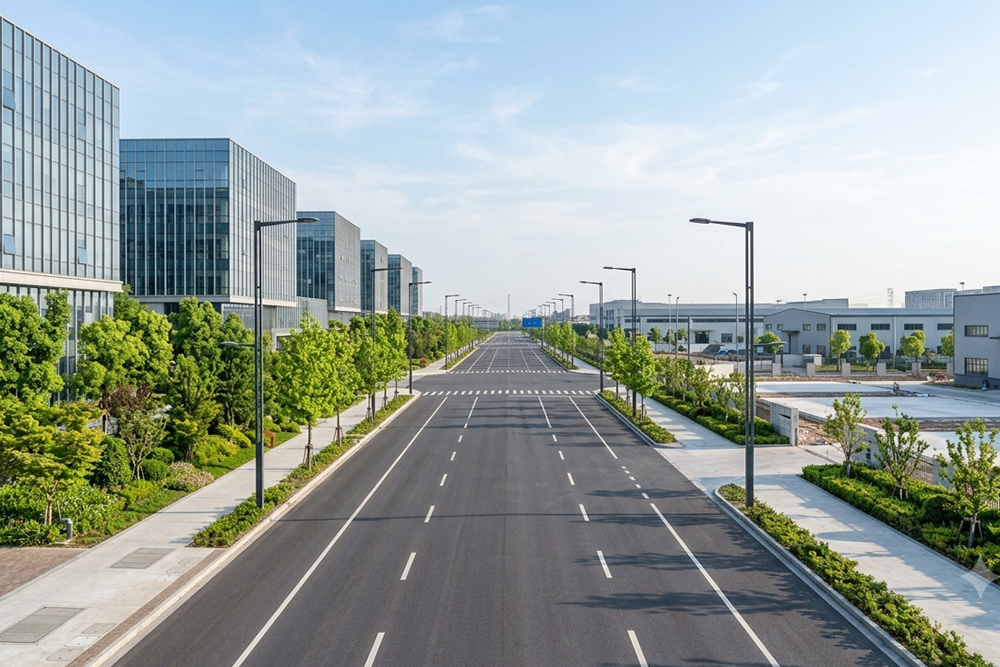
- Sensored Smart Roads: Wide arterial roads equipped with LED lights, CCTV security, and traffic monitoring sensors.
- Integrated Command & Control Center (ICCC): Located in the central ABCD building, this high-tech facility manages traffic, streetlights, and civic services in real time.
- Anchor Investments: High-tech projects like the Tata Semiconductor Fab and large renewable power parks anchor this zone, providing early employment and driving demand for nearby residential development.
Why Dholera’s Urban Layout Sets a New Standard
By combining a flexible global master plan with systematic Town Planning schemes, Dholera eliminates the guesswork from urban investment and industrial setup.
- For Businesses: Instant setup with pre-laid infrastructure and direct express links to ports and airports.
- For Residents: A clean city layout with green space, walkability, low pollution, and reliable utilities.
- For Real Estate Investors: Clear land zoning maps that show exactly where and when growth will happen.
Dholera isn’t just expanding; it is following a clear, well-structured blueprint for future growth.
What’s Your Take?
Are you looking at Dholera from an industrial, commercial, or residential point of view? Which TP zone matches your long-term goals best?