
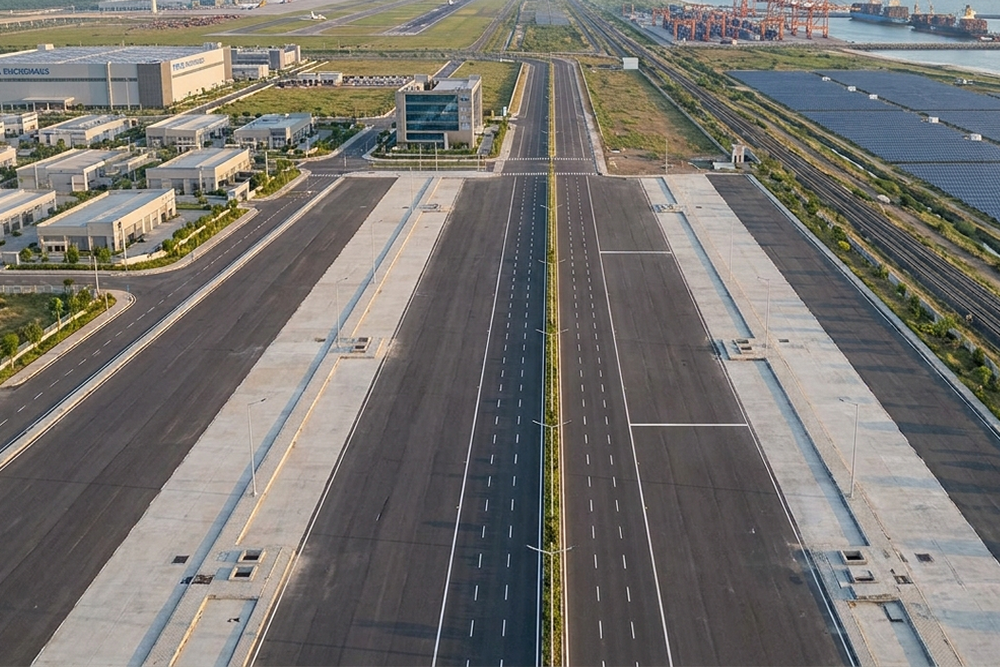
When you look at how most manufacturing hubs grow, it usually happens by accident. A few factories pop up near a highway, a small town expands around them, and before long, you have total gridlock. Heavy trucks get stuck in local traffic, power cuts slow down production, and expanding a facility becomes a legal nightmare.
Dholera is taking a completely different approach. Instead of letting industrial growth happen randomly, Gujarat is building a 920-square-kilometer region designed specifically for heavy industry, electronics, and global supply chains from day one.
If you’re tracking where serious industrial capital is moving in India, here is what’s actually happening on the ground.
The Big Magnet: High-Tech & Semiconductor Manufacturing
The real turning point for Dholera’s industrial credibility came with high-tech manufacturing. For years, India relied almost entirely on imported microchips. That narrative is finally shifting right here.
- Tata’s Semiconductor Plant: Tata Electronics, alongside Taiwan’s PSMC, is setting up India’s first commercial semiconductor fabrication facility in Dholera’s Activation Area. With an investment crossing ₹91,000 crore, this single project puts the region on the global tech map.
- The 363-Acre Supplier Park: A chip plant can’t run in isolation. Right next door, a dedicated 363-acre vendor park is being built for specialized chemical suppliers, gas providers, and precision toolmakers.
- Ancillary Ecosystem: Companies like INOX Air Products are setting up dedicated industrial gas units nearby, making sure the core supply chain stays within a few miles of the main fabs.
Beyond Microchips: Who Else is Setting Up Base?
While semiconductors get most of the headlines, Dholera’s industrial zone is divided into clear sectors so different industries don’t run into each other’s way.
Here is how the major players break down across key sectors:
- Semiconductors & Electronics: Key names like Tata Electronics, PSMC, and NextGen Semiconductors are anchoring domestic chip production and component assembly.
- EVs & Heavy Industry: Groups like Tsingshan Holding are bringing large-scale manufacturing, including EV battery lines and specialty steel production.
- Renewable Energy: Companies like ReNew Power, Tata Power, and Grew Energy are establishing solar module manufacturing, backed directly by the massive 5,000 MW Dholera Solar Park.
- Data Infrastructure: Tech and engineering giants like L&T Vyom are building out hyperscale data centers to power real-time computing and AI workloads.
- Aerospace & Defense: Aerospace collaborations, including assembly initiatives involving Adani and Embraer, are laying the groundwork for regional aircraft manufacturing and maintenance hubs.
Why Factory Owners Are Actually Moving Here
If you ask an operations head why they would choose a brand-new region over an established industrial estate, it usually comes down to three practical reasons:
- True Plug-and-Play Land: You don’t have to spend two years negotiating with local utility boards just to get basic infrastructure. Power lines, water connections, gas pipelines, and high-speed fiber are brought straight to the plot boundary before you even start digging foundations.
- Built-in Freight Connectivity: Transporting finished goods is straightforward. Industrial units link directly to the Ahmedabad–Dholera Expressway, the Western Dedicated Freight Corridor, and nearby sea ports like Pipavav and Kandla.
- Reliable Green Power: With the massive 5,000 MW solar park right next door, companies can meet strict global sustainability requirements without relying on dirty backup power.
What This Means for Real Estate and Local Jobs
Industrial development doesn’t happen in a vacuum. When major factories move in, people follow.
The initial wave of industrial projects is set to create over 20,000 direct technical and engineering jobs, plus thousands more in logistics, plant security, construction, and maintenance.
All those employees need places to live, schools for their kids, hospitals, and shopping centers. That is why land values in the surrounding Town Planning (TP) residential zones are seeing steady, organic demand. It isn’t just speculative hype it’s driven by real physical factories being built down the road.
Dholera is proving that when you get the industrial foundation right, everything else falls naturally into place.
What are your thoughts on Dholera’s industrial pace? Are you looking at the region from a supply chain perspective, or as a long-term real estate investor following the workforce growth?